
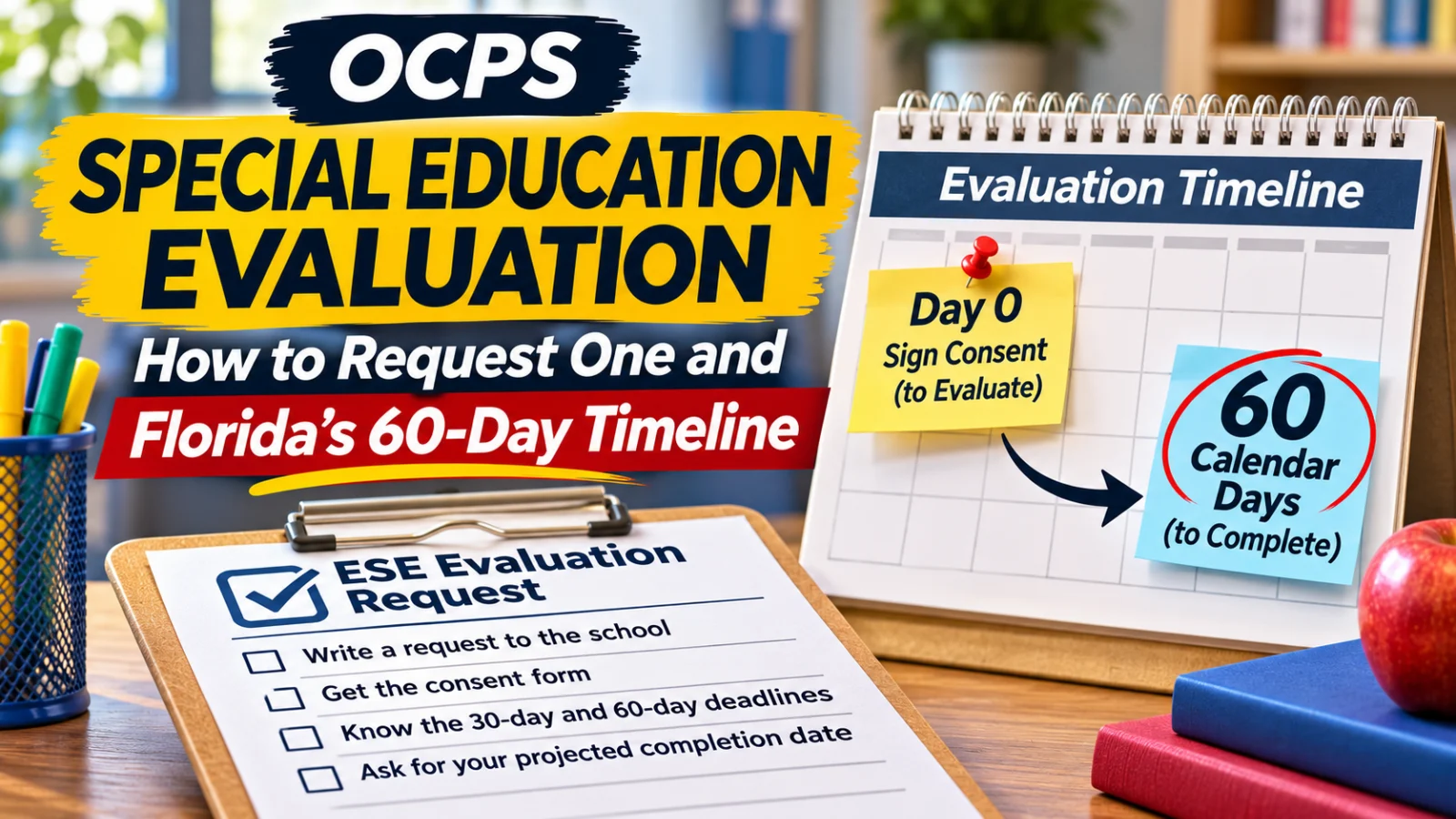
You can ask OCPS in writing to evaluate your child for special education. The district then has 30 days to get your consent or explain in writing why it refuses, and once you sign consent, Florida gives it 60 calendar days to finish, with breaks like Thanksgiving not counted.
If you think your child may have a disability that affects learning, you do not have to wait for the school to bring it up. Under Florida's evaluation rule, Rule 6A-6.0331, Florida Administrative Code, either a parent or the school district may start a request for an initial evaluation to decide whether a student has a disability and needs special education. Orange County Public Schools calls special education Exceptional Student Education, or ESE.
The rule was last amended September 23, 2025, when the state added district closures for inclement weather or natural disasters to the days that do not count. The timeline itself is 60 calendar days, not 60 school days, and has been for consents received since July 1, 2015. Here is how the request works, what the deadlines are, and what to do this week if you are worried.
How do I ask for an evaluation?
Put it in writing to your child's school. Address an email or letter to the principal, and copy your child's teacher and, if you know who it is, the school's ESE staffing specialist. If you don't have the name, ask the principal or front office. Say plainly that you are requesting an initial evaluation for exceptional student education, describe what you are seeing, and ask the school to send you the consent form. Keep a copy with the date you sent it.
The rule does not require a specific form for a parent request. Writing it down gives you a dated record, which matters because the first deadline runs from your request.
What does the school have to do after I ask?
Under the rule, when a parent requests an evaluation, the school district must, within 30 days and unless you and the school agree otherwise in writing, do one of two things:
Obtain your consent for the evaluation, or
Give you written notice explaining why it refuses to conduct the evaluation.
The OCPS Referrals and Evaluations FAQ, checked November 12, 2026, says that if the district refuses, the written notice must explain why, describe each evaluation procedure, assessment, record or report it relied on, describe other options it considered and why they were rejected, and list any other relevant factors.
Does my child have to go through MTSS interventions first?
Not if you ask for an evaluation. The OCPS FAQ says that if a parent requests an evaluation while the school's MTSS team is running general education interventions, the district must obtain consent and complete the evaluation within the 60 day timeline. The intervention process continues as part of the evaluation.
The FAQ also says interventions are not required before a referral when a student is suspected of being gifted, is being considered for homebound or hospitalized services, or is not enrolled in public school. The team and parent can also decide interventions are not appropriate when the nature or severity of the concern calls for faster action.
What am I agreeing to when I sign consent?
The OCPS FAQ defines consent as agreeing in writing after you have been given all relevant information, and it says consent "is voluntary on the part of the parent and may be revoked at any time." The rule says the district must give you written notice describing the evaluation procedures it proposes.
Two details surprise parents:
Consent is all or nothing. The OCPS FAQ says a parent "provides consent or refuses consent for the evaluation as a whole," not for some tests and not others.
Consent to evaluate is not consent to services. The rule says parental consent for an initial evaluation "must not be construed as consent for initial provision of ESE." If your child qualifies, the school must ask for your consent again before starting services.
How long does the evaluation take?
Rule 6A-6.0331 says the district "shall ensure that initial evaluations of students... suspected of having a disability are completed within sixty (60) calendar days after the school district's receipt of parent consent for evaluation."
These days do not count toward the 60, according to the rule:
School holidays and the Thanksgiving, winter and spring breaks adopted by the school board
Summer vacation, from the day after the last day of school to the first day of school
The days a student is absent, when the student misses more than eight school days in the 60 day period
Days the district is closed for inclement weather or a natural disaster, if the Governor authorized the closure by emergency order and other conditions in the rule are met
Weekends are calendar days, so they do count.
The OCPS FAQ words the timeline a little differently. It says the evaluation "must be completed within 60 calendar days which the student is in attendance after the school district receives parental consent." The state rule is the controlling text, so if you are counting days, use the rule's list of excluded days and ask the school to tell you, in writing, the date it has calculated.
What does that mean if I sign consent before Thanksgiving?
Thanksgiving Break and Winter Break pause the clock. The 2026 to 2027 OCPS school calendar lists Thanksgiving Break as Monday, November 23, 2026, through Friday, November 27, 2026, and Winter Break as Monday, December 21, 2026, through Friday, January 1, 2027. Under the rule, none of those days count toward the 60.
So by our count of the rule's excluded days, which here are the full Thanksgiving Break week and the two week Winter Break, a consent signed in mid November 2026 will not come due until about the end of January or early February 2027, and later if your child misses more than eight school days. Ask the school for the projected completion date when you sign, and put it on your calendar.
Can the deadline be extended?
Only in limited cases. The rule says the 60 day timeframe does not apply if:
You and the district agree in writing to extend it by no more than 30 calendar days. That agreement must be signed before the 45th calendar day, after formal testing has begun, when the team decides other evaluators are needed.
The parent repeatedly fails or refuses to bring the student for the evaluation.
The student moves into the district after the clock started at another district, and the new district is making sufficient progress and agrees with the parent on a specific completion date.
You never have to agree to an extension. If you are asked to sign one, ask what additional evaluation is needed and who will do it.
What about gifted evaluations?
Gifted evaluations follow a different timeline. The rule says students suspected of being gifted must be evaluated within a reasonable time set in the district's ESE policies and procedures, "but no more than ninety (90) school days that the student is in attendance after the school district's receipt of parental consent."
What happens after the evaluation?
The team, including you, meets to decide whether your child is eligible. If your child qualifies, an individual educational plan, or IEP, is developed, and the school must get your consent before it starts services. If your child does not qualify for ESE, ask whether a Section 504 plan should be considered. Our Tuesday, November 17, 2026, guide to IEP and 504 plans explains the difference, and the OCPS Section 504 Documents page posts the district's 504 FAQ and safeguards.
Who do I call if the school does not respond?
Start with the principal and the school's ESE staffing specialist. If the concern is not resolved, the district's Dispute Resolution page says parents may contact the district ESE office through the parent support ticket or explore other options listed by the Florida Department of Education. The district's Exceptional Student Education page links the Parent Support Ticket and lists the ESE office at 1600 E Kaley St., Orlando, FL 32806, 407 897 6420.
Send your written request this week, before Friday, November 20, 2026, ask for the consent form in the same email, and when you sign it, ask the school to write down the date it expects the evaluation to be finished.