
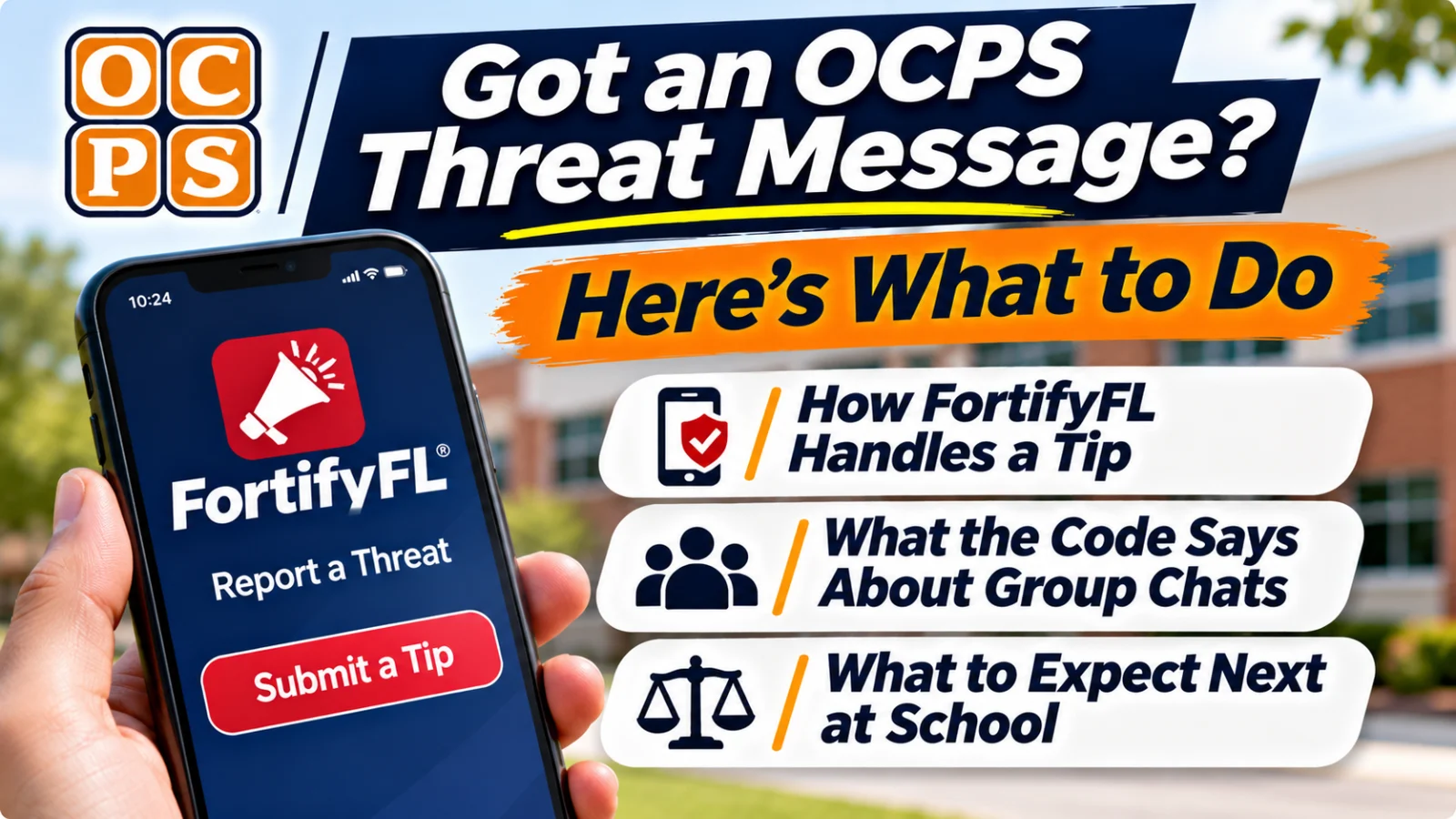
A screenshot in a group chat can turn a scared kid into a suspect. Here is how to report one the right way.
When an Orange County Public Schools student sees a threat against a school, the safest move is to report it once, through FortifyFL or a school adult, and not to forward it anywhere else. The 2026 to 2027 OCPS Code of Student Conduct, checked November 4, 2026, says a student who reposts a threat "will be presumed to have made a threat as if he/she were the initial poster/sender."
On the district’s Code of Student Conduct page, select “Updated COSC 9.8.26 English” to open the English Code PDF.
How a FortifyFL tip reaches the school and police
FortifyFL is Florida's statewide tip app for reporting threats and dangerous or criminal activity at school. The Legislature created it in 2018 as part of the Marjory Stoneman Douglas High School Public Safety Act, and students at that school named it, according to the FortifyFL website. The state law behind it is section 943.082, Florida Statutes.
A tip can be sent three ways, the OCPS Code says: through the FortifyFL app, from the app on the student's school issued device, or online at getfortifyfl.com. State law requires every district to install the app on school issued mobile devices, bookmark the site on school issued computers and teach students how to use it within the first five days of each school year.
The tip goes to school officials and local law enforcement at the same time. The FortifyFL site says reports route automatically to "your local school officials," that the local police department or sheriff's office "receive copies of your tips automatically," and that state level officials also have access.
Your child decides whether to give a name. Under section 943.082, the app must tell the person reporting that a tip can be anonymous, and that a name, if given, goes to law enforcement and school officials, who must keep it confidential. Tips can include photos and video, and the site says users can go back to earlier tips and add information.
There is one exception to anonymity. If an investigation finds someone knowingly sent a false tip, the law says the device's IP address goes to law enforcement and the sender may face criminal penalties under section 837.05, Florida Statutes, which makes knowingly giving false information to police a first degree misdemeanor, or a felony in some cases. The OCPS Code adds that a student who knowingly sends a false tip may also face school discipline.
Group chat threats and the Code’s consequences
Report it, and stop there. Have your child tell a teacher, the principal or the school resource officer, or send a FortifyFL tip with the screenshot attached. The OCPS Safety Tips for Students page, checked November 4, 2026, lists those same adults and the anonymous SpeakOut Hotline at 800 423 8477. For violence happening right now, the page says to call 911.
Then tell your child not to share it. The Code says "spreading rumors or reposting any information through social media that causes a disruption to the school environment will not be tolerated." A student who reposts a threat by text or social media is presumed to have made it, which "will lead to disciplinary action and possible criminal penalties."
The Code also covers posts about guns. A student who posts statements "alluding to the student bringing a firearm or other weapon" onto school property, a bus or a school activity is presumed to cause a disruptive environment, even if no weapon shows up. That includes students who post such statements "as a self-defense tactic."
Students may refuse to take part in a discipline investigation, the Code says, though the school can still finish it. Our school searches guide covers what staff can check in a backpack or phone.
The Code sets a default consequence of at least one full school year of expulsion and referral to law enforcement for a qualifying school threat or false report, "regardless of intent." But section 1006.07(2)(m), Florida Statutes, allows the superintendent to ask the School Board to modify the requirement by assigning the student to a disciplinary program or second chance school when that serves the student and school system.
Under section 790.163, Florida Statutes, a false report about a bomb, explosive or weapon of mass destruction, or about using firearms in a violent manner, is a second degree felony; a judge may order restitution when police or agencies respond. Section 836.10 also makes sending or posting a written or electronic threat to kill, do bodily harm, or conduct a mass shooting or act of terrorism a second degree felony. Section 790.162 covers threats to use a destructive device.
The Code also sets separate discipline safeguards for students covered by IDEA or Section 504, including review of whether the behavior was related to the disability. Ask the school which procedures apply before treating the default sanction as a final decision.
Saying "I was joking" does not automatically excuse a threat under the Code. The Code lists threats to the school as a zero tolerance offense that must be reported to law enforcement, and it says threats can be direct or indirect, spoken, written or posted. A pre arrest delinquency citation, which can steer some students away from court, is not available for threats to the school, the Code says.
School threat teams and your child’s records
Every Florida public school must have a threat management team under section 1006.07(7), Florida Statutes. The team must include people with expertise in counseling, instruction, school administration and law enforcement, and at least one member has to know the student personally.
The law also sets a parent notice rule. When the team makes a preliminary determination that a student poses a threat of violence or physical harm to himself, herself or others, it must report that to the superintendent or a designee, who "shall immediately attempt to notify the student's parent or legal guardian."
The same section says school staff can still act right away to stop an imminent threat.
The OCPS Code says any discipline investigation involving a threat goes to the School Threat Management Team, which is set up under Board Policy JICK, last revised May 12, 2026. The policy requires at least four core members on each school's team and says the team chair must contact the parent of a student who was the target of a threat.
State law says a threat assessment report and its documentation are part of the student's education record. After a discipline investigation ends, the Code says the parent of the student being disciplined may request a copy of the documentary evidence. Video used as evidence may be reviewed by that parent but will not be copied.
That record can follow your child. The Code says records sent to a new school must include "any threat assessment report" and related documentation, under section 1003.25, Florida Statutes. A parent may ask for a copy of what was sent.
Reading the alert and talking to your child
Board Policy JICK says the superintendent or a designee must "timely notify" parents of threats, unlawful acts and significant emergencies on school grounds, on school buses or at school activities, following state rules on timing and content. When a message arrives, read the whole thing before you act, and look for two things: whether law enforcement has reviewed the threat, and whether school is running on a normal schedule. If the message says to keep your child home or pick up early, follow it. If it does not, the decision is yours, and an absence is reported to the school the usual way.
Talk to your child the same night. Ask what they saw, who sent it and whether they shared it, and keep the screenshot. If your child forwarded it, call the principal the next morning before the school calls you.
Save the reporting options on your child's phone now. The FortifyFL app is in the App Store and Google Play, the web tip form is at getfortifyfl.com, and the SpeakOut Hotline is 800 423 8477. The main OCPS number is 407 317 3200.